


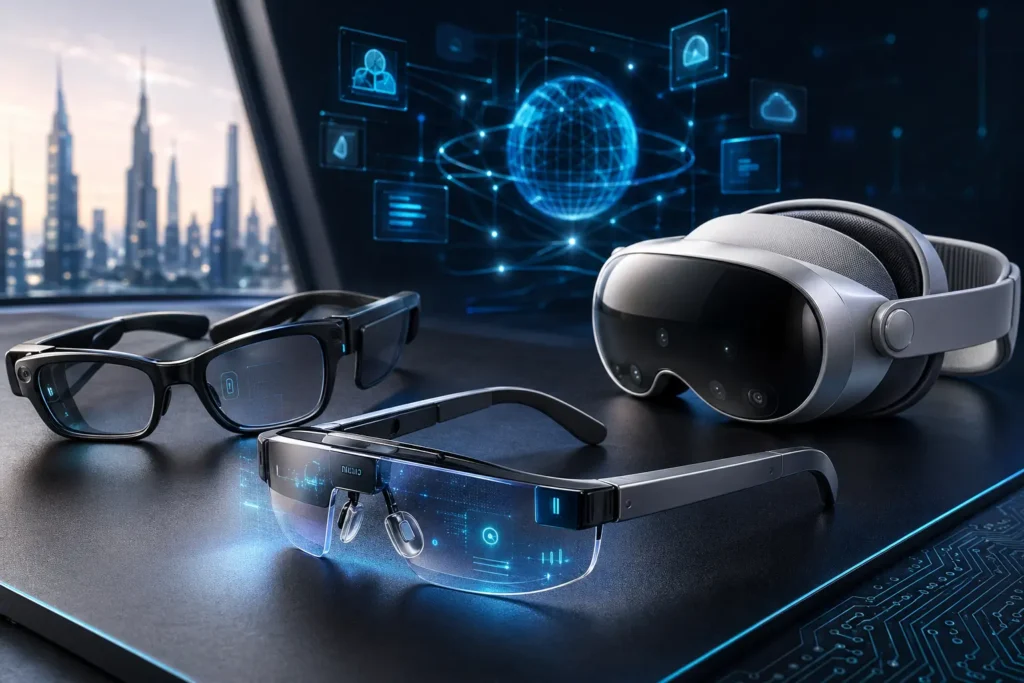
The promise of augmented reality glasses has been dangled in front of consumers for over a decade. In 2026, that promise is finally beginning to materialize. The best AR glasses and smart glasses of 2026 range from stylish everyday wearables to powerful spatial computing headsets — and for the first time, some of them are genuinely worth buying. Whether you want AI-powered smart glasses that look completely normal or a full spatial computing experience, there is now a product that can deliver it.
This guide covers the top AR and smart glasses of 2026, what spatial computing actually means for everyday users, and an honest assessment of whether the technology is ready for mainstream adoption.
What Are AR Glasses and Smart Glasses?
It helps to distinguish between two categories that are often confused:
- Smart glasses look like normal eyewear and add audio, cameras, AI assistants, and notifications without projecting any visual overlay onto the lenses. They are fashion-forward and practical today.
- AR glasses (augmented reality glasses) project digital information — navigation, notifications, data overlays, interactive elements — directly onto the lenses in front of your eyes. They merge the digital and physical worlds visually.
- Spatial computing headsets create fully immersive mixed-reality environments that blend digital and physical space in three dimensions, typically at the cost of a larger form factor.
Best Smart Glasses and AR Glasses of 2026
1. Meta Ray-Ban Smart Glasses (2026 Edition) — Best Everyday Smart Glasses
Meta’s Ray-Ban smart glasses have evolved from a clever curiosity into the most compelling everyday wearable of 2026. The latest generation adds a small but significant upgrade: a subtle heads-up display that shows notifications and brief AI responses as a discreet overlay visible only to the wearer. This bridges the gap between pure audio smart glasses and true AR.
The 2026 Meta Ray-Bans still look exactly like normal Ray-Ban frames. The built-in Meta AI assistant responds to voice commands, can identify objects and people in your field of view, answer questions about what you are looking at, translate text in real time, and handle calls and messages hands-free. Battery life is 4–6 hours of active use.
Best for: Everyday wearers who want AI assistance and social connectivity in a form factor they can actually wear in public.
Price: ~$329–$429
2. Google Android XR Glasses — Best Google Ecosystem AR Glasses
Google re-entered the smart glasses market in 2026 with Android XR Glasses, developed in partnership with Samsung. Unlike Google Glass (which was ahead of its time in 2013), Android XR Glasses in 2026 launch into a mature AI ecosystem. They run Android XR, Google’s operating system for extended reality devices, and integrate deeply with Gemini AI, Google Maps, Google Translate, and the Android app ecosystem.
The standout feature is real-time translation displayed as subtitles in your field of view during conversations — a genuinely transformative capability for international travel and multilingual environments. Google Maps navigation overlays walking directions directly onto the street ahead of you. The frames are designed with fashion-brand partnerships to look considerably more normal than previous AR attempts.
Best for: Android users, travelers, people who want functional AR overlays in a socially acceptable form factor.
Price: ~$499–$599 (launch pricing)
3. Apple Vision Pro 2 — Best Spatial Computing Headset
Apple’s Vision Pro 2 refines the original’s spatial computing concept with a lighter form factor (reduced from 600g to 420g), longer battery life (up to 3.5 hours), and a lower entry price of $2,499 — still expensive, but meaningfully more accessible than the original $3,499. The M5 chip powering Vision Pro 2 enables faster hand tracking, better passthrough quality, and more responsive visionOS interactions.
Vision Pro 2 remains the most capable spatial computing device available in 2026, with a rich library of native visionOS applications and seamless integration with Mac, iPhone, and iPad workflows. Using it feels genuinely futuristic — but the weight, limited battery, and price still prevent it from being an everyday device for most users.
Best for: Power users, creative professionals, developers building spatial computing applications, Apple enthusiasts who want the frontier experience.
Price: from $2,499
4. XREAL Air 3 — Best Value AR Glasses
XREAL (formerly Nreal) has established itself as the value leader in AR glasses, and the Air 3 continues that trajectory. Connecting via USB-C to a phone, laptop, or dedicated compute unit, the Air 3 projects a virtual display equivalent to a 201-inch screen at 6 meters — perfect for watching content, working on the go, or using as a portable monitor.
The Air 3 adds electrochromic lens dimming (adjustable tint for different environments), improved 3DoF tracking, and a wider field of view than its predecessor. At $449, it is the most accessible entry point into AR glasses for productivity and entertainment use in 2026.
Best for: Digital nomads, frequent travelers, anyone wanting a large virtual screen in a slim glasses form factor.
Price: ~$449
5. Samsung Galaxy Glasses (Android XR) — Best Samsung Ecosystem Option
Samsung’s own Android XR glasses, developed alongside Google as part of the Android XR platform, are optimized for the Samsung Galaxy ecosystem. They pair with Galaxy phones for seamless handoffs between devices and integrate with Samsung Health for biometric tracking. The design is notably slim for AR glasses, and Samsung’s manufacturing expertise shows in the build quality.
Best for: Samsung Galaxy users who want tightly integrated AR glasses in the Android ecosystem.
Price: ~$549
Is Spatial Computing Finally Here in 2026?
The honest answer is: yes and no.
For smart glasses, the technology is unambiguously ready. Meta Ray-Bans and Android XR glasses are practical, socially acceptable, and genuinely useful today. AI assistants, real-time translation, navigation overlays, and hands-free communication are working features that provide real value.
For full spatial computing in the Apple Vision Pro sense, the experience is extraordinary but the constraints are real: price, battery life, social acceptability in shared spaces, and the weight of wearing a computing headset for extended periods. These are solvable engineering problems — and Apple, Google, Meta, and Samsung are all solving them — but they are not fully solved in 2026.
The 2026 AR glasses landscape feels analogous to smartphones in 2008–2009: the technology clearly works, the killer use cases are emerging, and the next 3–5 years will bring the refinements that make this a mainstream everyday device for most people.
AR Glasses Comparison: 2026 At a Glance
| Device | Type | Key Features | Battery | Price (from) |
|---|---|---|---|---|
| Meta Ray-Ban (2026) | Smart glasses | Meta AI, camera, subtle HUD | 4–6 hrs | $329 |
| Google Android XR | AR glasses | Gemini AI, live translation, Maps nav | 4–5 hrs | $499 |
| Apple Vision Pro 2 | Spatial headset | visionOS, M5 chip, hand tracking | 3.5 hrs | $2,499 |
| XREAL Air 3 | AR display glasses | 201″ virtual screen, USB-C | N/A (tethered) | $449 |
| Samsung Galaxy Glasses | AR glasses | Android XR, Galaxy integration | 4–5 hrs | $549 |
What to Look for When Buying AR or Smart Glasses in 2026
Form Factor and Wearability
The best AR glasses are ones you will actually wear. Prioritize designs that look close to normal eyewear and feel comfortable for extended periods. Vision Pro 2 is extraordinary in capability but heavy; Meta Ray-Bans are light and normal-looking but less capable.
Ecosystem Fit
Match your glasses to your phone ecosystem. Android XR glasses work best with Android phones; Apple Vision Pro is Mac and iPhone native; Meta Ray-Bans work across platforms but are deepest in the Meta ecosystem. Trying to swim against your ecosystem means missing features.
Use Case Priority
Be honest about what you will use AR glasses for: entertainment and content consumption, productivity, navigation, AI assistance, or immersive spatial experiences. Different products optimize for different use cases, and no single device does everything well at any price in 2026.
Frequently Asked Questions: Best AR Glasses 2026
What are the best AR glasses in 2026?
The best AR glasses in 2026 depend on your use case. For everyday wearability and AI assistance, the Meta Ray-Ban Smart Glasses (2026) lead. For functional AR overlays with Google services, the Android XR Glasses are the top pick. For the most capable spatial computing experience, Apple Vision Pro 2 is unmatched — at a price.
Are AR glasses worth buying in 2026?
Smart glasses like Meta Ray-Bans and Android XR are genuinely worth buying in 2026 for users who want AI assistance, hands-free communication, and navigation overlays in a wearable form factor. Full spatial computing headsets like Vision Pro 2 are worth it for early adopters and professionals with specific use cases, but the price and constraints still limit mainstream appeal.
What is the difference between AR glasses and VR headsets?
VR headsets fully replace your visual field with a digital environment. AR glasses overlay digital information onto the real world — you can still see your surroundings. Mixed reality (like Apple Vision Pro) does both: it can fully immerse you in digital environments or blend digital objects into your real environment using passthrough cameras.
How long is the battery life on AR glasses in 2026?
Battery life varies significantly by device. Smart glasses like Meta Ray-Bans offer 4–6 hours of active use. AR headsets like Apple Vision Pro 2 last about 3.5 hours on the external battery pack. XREAL Air 3 is tethered and draws power from the connected device. Standalone AR glasses remain constrained by the challenge of packing meaningful battery into a slim frame.
What is spatial computing?
Spatial computing is the ability to interact with digital information in three-dimensional space, blended with the physical world. Rather than looking at a flat screen, spatial computing places virtual objects, apps, and interfaces around you in your real environment. Apple Vision Pro pioneered the consumer spatial computing category, and the broader industry — Google, Samsung, Meta — is now building competing platforms.