


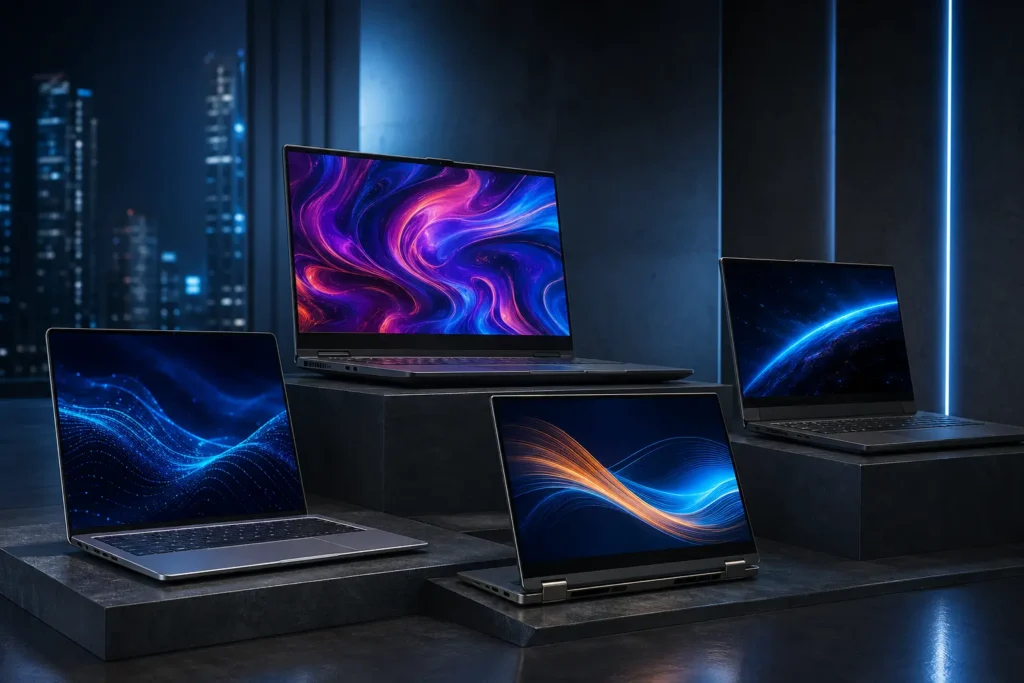
If you are shopping for a new laptop in 2026, the display is no longer an afterthought — it is the centerpiece. The best OLED laptops in 2026 have transformed what we expect from portable screens, offering true blacks, infinite contrast, and vivid color that no traditional LCD panel can match. What was once a premium rarity is now available across a wide range of price points, from budget ultrabooks to high-end creative workstations. Whether you are a content creator, a gamer, a remote professional, or simply someone who wants the best possible screen on the go, there has never been a better time to invest in an OLED laptop display. This guide covers the top picks, what to look for, and everything you need to know before you buy.
Table of Contents
- Why OLED Laptops Are Dominating in 2026
- OLED vs IPS LCD: Key Differences Explained
- Best OLED Laptops 2026: Top Overall Picks
- Best Budget OLED Laptops in 2026
- Best OLED Laptops for Creators and Professionals
- Best OLED Gaming Laptops in 2026
- What to Look for When Buying an OLED Laptop
- Frequently Asked Questions About OLED Laptops
- Conclusion
Why OLED Laptops Are Dominating in 2026
The shift toward OLED in the laptop market has been building for several years, but 2026 marks the tipping point. At CES 2026, the overwhelming majority of new premium and mid-range laptop announcements featured OLED panels. According to Tom’s Guide’s CES 2026 coverage, OLED displays now dominate laptop launches in a way that simply was not the case two years ago. Manufacturing yields have improved, panel costs have dropped, and every major laptop brand — ASUS, Dell, Lenovo, Samsung, Razer, LG, and Apple — now offers at least one OLED option.
The driving force behind this shift is consumer demand for better visual experiences. As remote work, content creation, streaming, and gaming converge on the laptop form factor, display quality has become a primary purchase driver. HDR content is now mainstream on Netflix, Disney+, and YouTube, and OLED panels are uniquely positioned to deliver that content with genuine impact. The other factor is competition: once one brand put OLED into a mid-range laptop, others followed quickly to stay competitive.
Additionally, power efficiency improvements in 2026-era OLED panels have addressed one of the technology’s historical weaknesses. Modern OLED displays draw less power during typical productivity tasks because individual pixels turn off completely when rendering dark or black content. This, combined with the latest Intel Panther Lake and AMD Ryzen AI 400 chips, has made OLED laptop battery life genuinely competitive with traditional IPS alternatives.
OLED vs IPS LCD: Key Differences Explained
Before diving into specific models, it helps to understand exactly what you gain — and what you should watch for — with an OLED laptop display versus a standard IPS LCD panel. The two technologies differ fundamentally at the hardware level, and those differences produce very real outcomes in everyday use.
Contrast, Color, and True Black Performance
The defining advantage of OLED is its ability to produce perfect blacks. Each pixel in an OLED display emits its own light and can turn off completely, resulting in an infinite contrast ratio. An IPS LCD, by contrast, uses a backlight that remains always on — even when displaying black content — leading to a characteristic glow known as backlight bleed. On an OLED laptop, black is genuinely black, dark scenes in movies look cinematic, and HDR content pops with a visual intensity that IPS simply cannot replicate. Color gamut coverage also tends to be wider on OLED panels, with most modern OLED laptops hitting 100% DCI-P3, the standard used in professional film and photo editing.
Response Time, Refresh Rate, and OLED Burn-In
OLED panels have near-instantaneous pixel response times — typically under 0.2 milliseconds — which is far faster than even the best IPS gaming displays. This results in zero motion blur during fast action, making OLED gaming laptops a compelling choice for competitive play. Refresh rates on 2026 OLED laptops now commonly reach 120 Hz, 144 Hz, and even 165 Hz, combining that instant response time with buttery-smooth motion. The one concern that persists with OLED is burn-in — the risk of permanent image retention from static elements like taskbars or menu bars. Modern 2026 OLED panels mitigate this with pixel-shift technology, logo dimming, and panel maintenance features, and real-world burn-in over typical laptop lifespans (three to five years) remains rare with normal usage patterns.
Best OLED Laptops 2026: Top Overall Picks
These are the standout best OLED laptops in 2026 across categories, selected for their combination of display quality, performance, build quality, and value.
1. ASUS Zenbook A16 (2026) — Best Overall OLED Ultrabook
The ASUS Zenbook A16 emerged as one of the most talked-about laptops of CES 2026, and for good reason. It weighs just 1.2 kg — making it one of the lightest 16-inch laptops ever made — while housing a stunning 16-inch 3.2K OLED display with 120 Hz refresh rate and 1,000 nits peak HDR brightness. The Ceraluminum lid material gives it a premium texture that feels distinct from typical aluminum laptops. Inside, it ships with AMD Ryzen AI 400 series processors, delivering serious CPU performance alongside a capable integrated Radeon GPU and a dedicated NPU for on-device AI tasks. The Zenbook A16 is the rare combination of extreme portability, gorgeous OLED display, and all-day battery life — a compelling alternative to the MacBook Air for Windows users seeking the best OLED screen available.
2. Apple MacBook Air 15-inch M5 — Best OLED-Class Display Experience on macOS
Apple continues to use Liquid Retina displays rather than OLED on the MacBook Air, but the 15-inch M5 model’s panel quality is remarkable enough that it belongs in any 2026 laptop display conversation. With True Tone, P3 wide color, and 500 nits of brightness, the display delivers excellent color accuracy for creative professionals. More importantly, the M5 chip inside is a generational leap: Apple claims up to 30% faster CPU performance and significantly improved GPU throughput compared to M4. The MacBook Air M5 also now starts with 512GB of storage standard, addressing a long-standing complaint. For users invested in the Apple ecosystem, the MacBook Air remains the benchmark for thin-and-light laptop performance — and if you want a true OLED display from Apple, the MacBook Pro 14-inch with its XDR Liquid Retina display delivers richer contrast closer to OLED territory.
3. Samsung Galaxy Book5 Pro 360 — Best 2-in-1 OLED Laptop
Samsung’s Galaxy Book5 Pro 360 is a 16-inch 2-in-1 convertible that ships with one of the finest OLED touchscreens available on any laptop in 2026. The Dynamic AMOLED 2X display delivers 2880×1800 resolution at 120 Hz with HDR True Black 400 certification — meaning it achieves 400 nits peak brightness on HDR highlights while rendering absolute blacks. Samsung’s color tuning produces accurate, vibrant imagery whether you are sketching in Samsung Notes with the included S Pen, editing photos in Lightroom, or watching HDR content. The Galaxy Book5 Pro 360 runs on Intel Core Ultra 300 (Panther Lake) processors in its latest configuration, offering a balanced blend of performance and efficiency. It is the go-to recommendation for anyone who wants the versatility of a tablet combined with the power of a laptop and an OLED display that rivals dedicated monitors.
Best Budget OLED Laptops in 2026
One of the most significant developments of 2026 is how far down the price ladder OLED laptop displays have reached. You no longer need to spend $1,500 or more to get a gorgeous OLED screen — several strong options now sit well under $1,000.
Acer Swift X 14 OLED — Best Value OLED Laptop Under $1,000
The Acer Swift X 14 has carved out a loyal following by delivering impressive specs at an aggressive price, and the 2026 OLED model continues that tradition. Priced around $999, it features a 14-inch 2.8K OLED display with 90 Hz refresh rate — sharp, vivid, and a genuine step up from the IPS panels on most sub-$1,000 rivals. Inside, the Swift X 14 runs on Intel Core Ultra 200H processors paired with an Intel Arc B390 integrated GPU, which is capable enough to handle light gaming alongside productivity and creative workloads. At just under 3.2 lbs, it is portable enough for daily commuting. For students, freelancers, and budget-conscious buyers who want OLED display quality without a premium price tag, the Acer Swift X 14 OLED is the standout pick of 2026.
Lenovo IdeaPad Slim 5 OLED — Best Entry-Level OLED Laptop
Lenovo’s IdeaPad Slim 5 OLED brings true OLED display quality to a price point around $799 — remarkable by any standard. The display is a 14-inch 2.8K 90 Hz OLED panel covering 100% DCI-P3, factory calibrated for color accuracy out of the box. It runs on AMD Ryzen 7 AI-series processors with integrated Radeon graphics, making it a solid everyday productivity machine. The build quality is plastic-heavy at this price point, and it lacks the premium materials of more expensive options, but the display itself punches well above its weight. If your top priority is getting an OLED screen on the tightest possible budget, the IdeaPad Slim 5 OLED is the most accessible entry point in 2026.
Best OLED Laptops for Creators and Professionals
Content creators, video editors, photographers, and designers have the most to gain from OLED display technology. The combination of wide color gamut, precise black levels, and high brightness makes OLED-equipped laptops far more reliable for color-critical work than most IPS alternatives.
LG Gram Pro 16 OLED — Best for Long-Duration Creative Work
LG’s Gram series has always been synonymous with ultralight portability and marathon battery life, and the Gram Pro 16 OLED builds on that reputation with a 16-inch 3.2K WQXGA+ OLED display at 120 Hz. What makes the Gram Pro 16 stand out for creative professionals is the combination of display quality and endurance — LG claims up to 22 hours of real-world battery life on a single charge, which is extraordinary for an OLED laptop. The panel covers 100% DCI-P3 with Delta E < 2 factory calibration, making it suitable for photo and video editing without requiring a separate monitor calibration profile. At just 1.35 kg, it is one of the lightest 16-inch OLED laptops available anywhere.
ASUS ProArt Studiobook 16 OLED — Best OLED Laptop for Pro Creatives
For professionals who need uncompromising display accuracy alongside powerful discrete graphics, the ASUS ProArt Studiobook 16 OLED is the benchmark. It ships with a 16-inch 4K OLED touchscreen display with 120 Hz refresh rate, Delta E < 1 color accuracy, 550 nits peak brightness, and PANTONE Validated certification — meaning its color rendering has been independently verified to match the physical PANTONE color standard. It pairs this display with Intel Core Ultra 9 processors and NVIDIA RTX 5000-series Laptop GPUs, giving video editors and 3D artists a machine capable of handling 8K footage, complex simulations, and AI-accelerated rendering. It is heavy and expensive, but for working professionals who need a laptop that doubles as a portable color-accurate workstation, nothing in 2026 rivals the ProArt Studiobook 16 OLED.
Best OLED Gaming Laptops in 2026
Gaming and OLED make a natural pairing. The instant pixel response time, perfect black levels, and vivid color reproduction of OLED displays elevate the gaming experience in a way that is genuinely hard to go back from. The best OLED laptops 2026 for gaming also happen to pack the most powerful hardware of any laptop category. According to ASUS’s official 2026 TUF Gaming lineup announcement, OLED panels are now standard across the entire TUF family — a clear signal that OLED has become the expected baseline for gaming laptop displays.
Razer Blade 16 (2026) — Best Premium OLED Gaming Laptop
Razer’s 2026 Blade 16 is a statement in engineering achievement. It features a dual-mode 16-inch QHD+ 240 Hz OLED display capable of switching between its full 4K resolution at 60 Hz and a QHD+ 240 Hz mode optimized for gaming — giving you the best of both worlds depending on what you are doing. Under the hood, it ships with Intel Core Ultra 9 Panther Lake processors and NVIDIA RTX 5090 Laptop GPU options at the top end, representing the fastest laptop gaming hardware money can buy in 2026. Razer claims a 60% improvement in battery efficiency versus the previous generation, thanks to LPDDR5X-9600 MHz memory and the improved power management of the new platform. At around $3,499 for base configurations, it is expensive — but it remains the gold standard for premium gaming laptop OLED displays.
ASUS TUF Gaming A18 OLED — Best Mid-Range OLED Gaming Laptop
Not every gamer needs — or can afford — the Blade 16. The ASUS TUF Gaming A18 hits a significantly more approachable price point while still delivering a genuinely impressive gaming OLED experience. Its 18-inch 1080p 165 Hz OLED display is optimized for pure gaming performance: the fast refresh rate and sub-0.2ms response time mean every frame renders with razor-sharp clarity. It ships with AMD Ryzen 9 8940HX processors and NVIDIA RTX 5070 Ti Laptop GPU, providing performance capable of handling all current AAA titles at high settings. The A18’s larger 18-inch chassis allows for better thermal management and a full-size numpad keyboard, making it a surprisingly comfortable daily driver for those who do not mind a larger bag. For gamers who want OLED without the Razer price tag, the TUF A18 is the most compelling option of 2026.
What to Look for When Buying an OLED Laptop in 2026
With so many OLED laptop options now available, knowing which display specifications actually matter will help you make a smarter purchase. Here are the key factors to evaluate when comparing the best OLED laptops 2026 has to offer.
Resolution and Pixel Density
Higher resolution means sharper text and finer image detail, but it also increases demands on the GPU when gaming. For productivity and creative work, a 2.8K or 3K resolution on a 14–16-inch screen hits the sweet spot — sharp enough that individual pixels are invisible at normal viewing distances, yet not so demanding that it drains the battery rapidly. For gaming-focused laptops, 1080p at 165+ Hz or 1440p at 120–165 Hz often makes more sense than 4K at 60 Hz, because the fast refresh rate does more for gameplay feel than raw pixel count. Look for displays described as 2.8K, 3.2K, or QHD+ — these deliver excellent pixel density on modern screen sizes.
Brightness, HDR Certification, and Color Gamut
OLED brightness is measured both as sustained brightness and peak HDR brightness. For outdoor usability, look for at least 400 nits of sustained brightness — several 2026 OLED laptops now reach 500–600 nits, which is a real improvement over earlier generations. HDR certifications to look for include VESA DisplayHDR True Black 400 or 500, which confirm genuine HDR performance on OLED. For color-critical work, confirm that the panel covers 100% DCI-P3 and carries a Delta E accuracy rating of 2 or below — ideally less than 1 for professional creative use.
Refresh Rate and Response Time for Gaming and Productivity
For everyday productivity and content consumption, a 60 Hz or 90 Hz OLED display is perfectly smooth. However, if you plan to use your laptop for gaming or creative applications like Premiere Pro or DaVinci Resolve — where smooth timeline scrubbing matters — look for at least 120 Hz. Gamers should prioritize 144 Hz or faster. Refresh rate affects perceived fluidity across everything you do, not just gaming, so higher is generally better as long as your battery life expectations align.
Understanding OLED Burn-In Risk in 2026
Burn-in — permanent image retention from static screen elements — is the most common concern people raise about OLED laptops. In practice, modern 2026 OLED laptop panels have multiple protective features: pixel-shift algorithms that subtly move the image over time, automatic screen dimming after periods of inactivity, panel self-maintenance cycles that run on shutdown, and reduced brightness on persistent static elements like taskbars. Real-world burn-in on modern OLED laptops used under typical conditions over a three-to-five-year lifespan is rare. The risk is highest for users who leave static logos or toolbars on screen at full brightness for extended, uninterrupted periods — a usage pattern that most people do not follow naturally. For the vast majority of buyers, burn-in should not be a deterrent in 2026.
Frequently Asked Questions About OLED Laptops in 2026
Are OLED laptops worth it in 2026?
Yes, for most users an OLED laptop is absolutely worth it in 2026. Prices have dropped significantly, the technology is mature, and the visual improvement over IPS LCD is immediately noticeable. If you spend significant time streaming, editing photos or videos, gaming, or simply want the most immersive experience possible from your laptop screen, OLED is the right choice. For pure productivity tasks like spreadsheets and emails, the benefit is less dramatic — but you will still appreciate the sharper text rendering and lower blue light emissions that OLED provides.
Do OLED laptops have worse battery life?
Historically, OLED displays consumed more power during bright, colorful content — but this has changed significantly in 2026. Modern OLED panels are far more efficient than their predecessors, and because each pixel turns off individually in dark content, watching dark-themed movies or using dark mode in apps can actually consume less power than an always-backlit IPS display. Combined with more efficient processors in 2026-era laptops, the gap between OLED and IPS battery life has narrowed dramatically. Many 2026 OLED laptops now advertise 12–18 hours of real-world battery life.
What is the difference between OLED and AMOLED in laptops?
AMOLED stands for Active Matrix OLED and refers to the driving technology used to control each pixel in the display. In practical terms, OLED and AMOLED on laptops offer the same core visual benefits — true blacks, vibrant color, fast response times. Samsung tends to brand its OLED laptop panels as Dynamic AMOLED or Super AMOLED, while ASUS, LG, and others use OLED branding. Both refer to self-emissive pixel technology with the same fundamental advantages over backlit LCD panels. When evaluating laptops, look at the specific panel specs — resolution, brightness, refresh rate, color gamut — rather than the brand name of the OLED variant.
Conclusion: The Best OLED Laptops in 2026 Raise the Bar for What a Screen Can Be
The best OLED laptops in 2026 represent a genuine leap forward in portable display technology. From the featherlight ASUS Zenbook A16 to the powerhouse Razer Blade 16 and the accessible Acer Swift X 14, there is an OLED laptop for every use case and budget this year. The combination of true blacks, wide color gamut, instant pixel response, and increasingly competitive battery life makes OLED the display technology of choice for anyone who cares about what they see on their screen each day.
As PCWorld noted in their CES 2026 roundup, OLED is no longer a luxury feature — it is becoming the expected standard for premium and even mid-range laptops. If you are planning a laptop purchase in 2026, the short version is this: if an OLED version of your target laptop exists, it is almost always worth the modest premium. Your eyes will thank you.
Whether you are a creator hunting for the most color-accurate display you can take on the road, a gamer chasing the deepest blacks and fastest pixel response, or simply someone who wants the most beautiful screen experience possible in a laptop — the best OLED laptops of 2026 deliver exactly that. Use the recommendations in this guide to find the right match for your needs, budget, and workflow.