


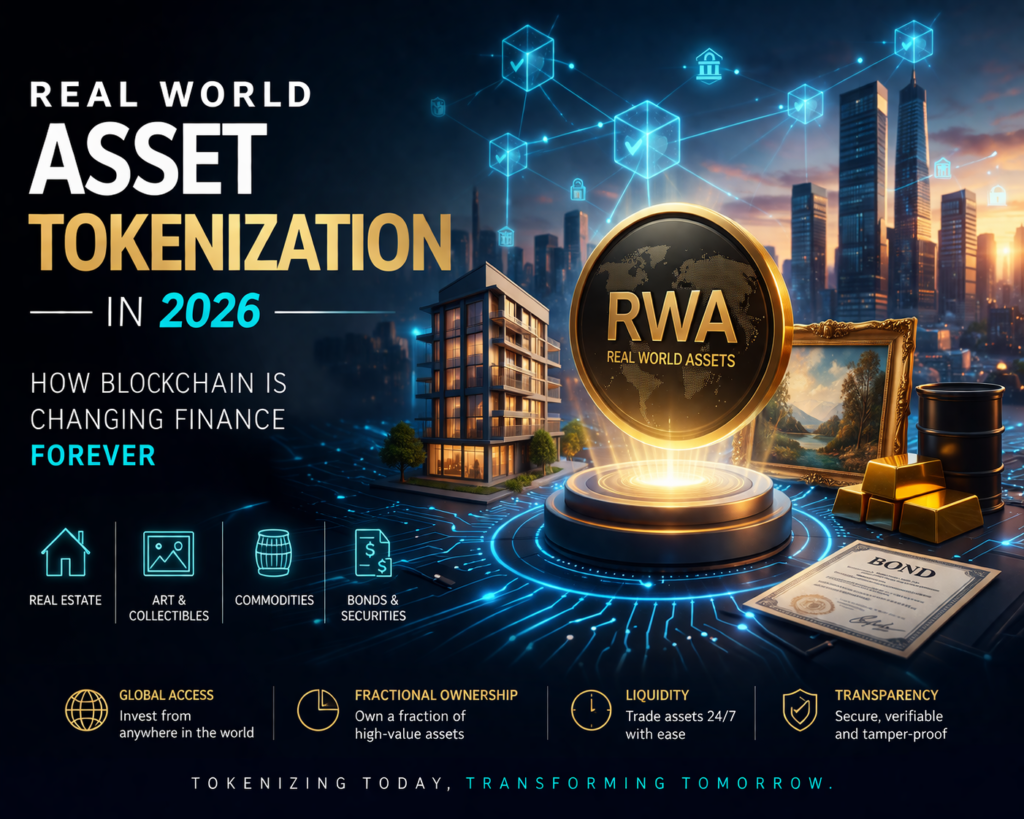
Real world asset tokenization is one of the most transformative movements in finance today. In 2026, the tokenization of physical and financial assets on the blockchain has moved far beyond experimental pilot programs and into the mainstream — with trillions of dollars in potential value waiting to migrate on-chain. From US Treasury bonds and private equity to real estate and fine art, the ability to represent ownership of real-world assets as digital tokens is fundamentally changing how people invest, trade, and access financial markets. In this comprehensive guide, we break down everything you need to know about real world asset tokenization in 2026: what it is, why it’s growing so fast, which platforms are leading the charge, and how you can get involved.
Table of Contents
- What Is Real-World Asset Tokenization?
- Why RWA Tokenization Is Exploding in 2026
- Top Real World Asset Tokenization Platforms in 2026
- How to Invest in Tokenized Real-World Assets
- Risks and Challenges You Need to Know
- The Future of Real World Asset Tokenization
- Conclusion
What Is Real-World Asset Tokenization?
Real world asset tokenization is the process of converting ownership rights of a physical or financial asset into a digital token recorded on a blockchain. Think of it as creating a digital certificate of ownership — except instead of a paper deed or a brokerage account statement, that ownership lives on an immutable, programmable blockchain ledger. These tokens can represent fractional shares of an asset, making it possible for everyday investors to own a slice of something that was previously out of reach: a Manhattan skyscraper, a vintage wine collection, or a bundle of US Treasury bills.
The concept is not entirely new — tokenization experiments have been running since at least 2017 — but 2026 is the year the technology crossed the chasm from theoretical to operational at scale. What changed? A powerful combination of regulatory clarity, institutional buy-in, mature blockchain infrastructure, and the proven use case of stablecoins converged to make real world asset tokenization not just possible, but profitable. Traditional financial institutions, DeFi protocols, and regulated fintech platforms are now all competing for the same market opportunity.
How Tokenization Works on the Blockchain
The mechanics of real world asset tokenization begin off-chain. A real-world asset — say, a commercial office building in Chicago — is first legally structured so that a special-purpose vehicle (SPV) or similar legal wrapper holds title to the asset. The token issuer then creates digital tokens on a blockchain (commonly Ethereum, Solana, or a permissioned chain like Polygon PoS) that represent proportional ownership rights in that SPV. Smart contracts govern the rules: who can hold the tokens, how distributions are paid out, how transfers are processed, and how redemptions work.
Once tokens are issued, they can be traded peer-to-peer on secondary markets, staked in DeFi protocols as collateral, or held in a digital wallet just like any other crypto asset. The key difference from traditional securities is settlement speed — while a traditional bond trade might take two business days to settle (T+2), tokenized assets can settle in seconds. That speed, combined with programmable compliance built directly into smart contracts, is what makes on-chain assets so attractive to both institutions and retail investors.
Types of Real-World Assets Being Tokenized
The universe of assets entering the tokenized asset ecosystem in 2026 is remarkably broad. The most mature category is fixed-income products — tokenized US Treasury bills, money market funds, and corporate bonds. These products found a natural audience in the DeFi ecosystem, where protocols were hungry for yield-bearing, dollar-denominated collateral. Ondo Finance’s OUSG token, for example, gives DeFi users direct exposure to short-dated US Treasuries without ever leaving the on-chain world.
Beyond fixed income, real estate tokenization has accelerated significantly. Platforms like RealT and Lofty allow investors to purchase fractional ownership of rental properties starting at just a few dollars, with rental income distributed automatically via smart contracts. Private credit and private equity — historically gated behind million-dollar minimums — are also being opened up through platforms like Securitize and Centrifuge. Even more exotic asset classes like fine art, luxury watches, carbon credits, and infrastructure projects are now entering the real world asset tokenization space. The common thread: illiquid, hard-to-access assets that benefit from blockchain-enabled fractional ownership and near-instant settlement.
Why Real World Asset Tokenization Is Exploding in 2026
Several powerful forces have converged to make 2026 the breakout year for real world asset tokenization. Understanding why the market is growing so rapidly requires looking at both the supply side — why institutions are issuing tokenized assets — and the demand side — why investors want them.
The Numbers Behind RWA Tokenization Growth
The data paints a compelling picture. Tokenized financial assets grew from roughly $5.6 billion to nearly $19 billion in a single year — and that figure is widely considered a conservative estimate that excludes stablecoins and many private credit products. According to the Coinbase Institutional 2026 Crypto Market Outlook, real world asset tokenization is among the top three themes driving institutional crypto adoption this year, alongside stablecoins and AI-blockchain convergence.
Projections from major consulting firms and blockchain analytics companies suggest the total addressable market for tokenized assets could reach $10 to $16 trillion by the early 2030s. Even at conservative adoption rates, that represents one of the largest wealth migration events in financial history. The World Economic Forum’s 2026 digital assets outlook described tokenization as representing an “inflection point” for global capital markets — enabling 24/7 settlement and borderless access to investment products that previously required expensive intermediaries and long settlement windows.
Institutional Players Driving the Real World Asset Tokenization Wave
One of the most important signals for real world asset tokenization in 2026 is who is building it. This is no longer just a DeFi-native story — global financial giants have entered the space with serious capital and infrastructure. JP Morgan’s Onyx division has been running its JPM Coin deposit token on a public blockchain for institutional clients, settling billions in intraday repo and cross-border payments. Citigroup integrated its Citi Token Services with 24/7 USD clearing for real-time cross-border transactions, effectively proving that tokenization works at institutional scale.
BlackRock’s BUIDL fund — a tokenized money market product launched on Ethereum — crossed $500 million in assets under management and became a model for how the world’s largest asset managers can bring traditional products on-chain. Franklin Templeton’s OnChain US Government Money Fund (FOBXX) similarly attracted institutional and retail capital seeking the dual benefits of yield and blockchain-native transferability. These moves from trillion-dollar asset managers have had a powerful legitimizing effect on the entire tokenized assets sector, reducing regulatory uncertainty and signaling to policymakers that the industry is ready for clearer frameworks.
Standard Chartered, meanwhile, is weighing a partial acquisition of crypto custodian Zodia — a move that underscores how traditional banks are racing to build the custody infrastructure that institutional real world asset tokenization will require. European digital asset manager CoinShares debuted on the Nasdaq in early 2026, valued at $1.2 billion, further cementing the convergence between traditional finance and the digital asset world.
Top Real World Asset Tokenization Platforms in 2026
The ecosystem of real world asset tokenization platforms has matured considerably over the past two years. Here are the most significant platforms operating in 2026, each serving different asset classes and investor profiles.
Ondo Finance: DeFi’s Gateway to Tokenized Institutional Assets
Ondo Finance has become the leading name in tokenized fixed-income products. Its flagship OUSG token gives holders exposure to BlackRock’s iShares Short Treasury Bond ETF, effectively bringing US government bond yields into the DeFi ecosystem. USDY — Ondo’s yield-bearing stablecoin backed by short-term US Treasuries — crossed $1 billion in circulation in early 2026, validating the demand for on-chain yield products that go beyond simple non-yielding stablecoins.
What makes Ondo particularly interesting is its infrastructure play. Ondo Chain — its own layer-1 blockchain purpose-built for institutional-grade real world asset tokenization — entered mainnet in 2026. The chain is designed with native compliance modules that allow token issuers to embed KYC/AML checks directly at the protocol level rather than relying on application-layer whitelists. This approach could become the blueprint for compliant tokenized asset infrastructure across the industry.
Centrifuge, Maple Finance, and the Private Credit Revolution
Private credit has historically been one of the most exclusive asset classes in finance — dominated by hedge funds and family offices with multi-million-dollar minimum investments. Centrifuge has been methodically dismantling that barrier since 2021, and in 2026 its platform hosts dozens of pools representing real-world loans to small and medium-sized businesses, invoice financing facilities, and real estate bridge loans. Each pool is tokenized into senior and junior tranches, giving investors the ability to choose their preferred risk-return profile within a single digital securities framework.
Maple Finance approaches the same market from a different angle, focusing on institutional borrowers who can access undercollateralized loans based on their on-chain reputation and off-chain credit assessments. After rebuilding with more robust underwriting standards post-2022, Maple is now originating hundreds of millions in loans to both crypto-native institutions and traditional businesses seeking blockchain-based credit facilities. The appeal is mutual: borrowers get faster, cheaper access to capital, and lenders get transparent, on-chain loan performance data that traditional credit markets can’t match.
Securitize, which partnered with TRON blockchain in early 2026 to expand RWA token distribution globally, has become the leading regulated transfer agent and digital securities issuance platform in the US market. Its work with BlackRock’s BUIDL fund has positioned it as the compliance infrastructure layer for institutional tokenization — a role that grows more valuable as more asset managers look to bring products on-chain.
Plume Network and Real Estate Tokenization Platforms
Real estate has always been a natural fit for real world asset tokenization — it’s illiquid, difficult to access for average investors, and represents the world’s largest asset class by value. RealT pioneered the fractional real estate model on Ethereum, allowing investors worldwide to buy tokens representing shares of US rental properties. Token holders receive daily rental income in stablecoins, proportional to their holdings. The model proved compelling enough that RealT now manages hundreds of properties across multiple US cities, with investors from over 150 countries participating.
Plume Network — a blockchain purpose-built for yield-bearing tokenized assets — emerged as one of the breakout infrastructure stories of early 2026, processing over $1.25 billion in asset commitments within weeks of its mainnet launch. Plume’s differentiation lies in its native integration with compliance and identity verification tools, making the onboarding of institutional-grade real-world assets significantly smoother than on general-purpose blockchains. Its focus on yield-generating RWA assets positions it squarely at the intersection of DeFi demand and TradFi supply.
How to Invest in Tokenized Real-World Assets in 2026
Getting exposure to real world asset tokenization opportunities in 2026 is more accessible than ever, though the path varies depending on what type of asset you’re interested in and your jurisdiction. Here’s a practical breakdown for different types of investors.
For retail investors seeking yield: The easiest entry point into the tokenized asset ecosystem is a yield-bearing stablecoin or tokenized money market fund. Products like Ondo’s USDY, Mountain Protocol’s USDM, or similar offerings allow you to hold a dollar-pegged token while earning yields comparable to short-term US Treasury rates — currently in the 4–5% range. These can typically be purchased directly through DeFi protocols or regulated platforms like Coinbase. Always verify that the product you’re buying is backed by the assets it claims — look for regular third-party attestations and transparent on-chain proof of reserves before committing capital.
For accredited investors: Platforms like Securitize, Backed Finance, and Figure Markets offer access to tokenized private credit, private equity, and fund products that are only available to qualified investors under existing securities law. The minimums vary — some start as low as $1,000, while others maintain higher thresholds — but the liquidity and transparency advantages over traditional alternatives are meaningful. A tokenized private credit fund that previously required a multi-year lockup might now offer quarterly liquidity windows with secondary market trading facilitated entirely on-chain.
For DeFi-native investors: The most sophisticated entry points involve using tokenized real-world assets as collateral within DeFi lending protocols. MakerDAO (now Sky), Aave, and Morpho Blue all accept various tokenized asset types as collateral, allowing you to borrow stablecoins against your RWA holdings without selling them. This creates capital efficiency that doesn’t exist in traditional finance — imagine using your tokenized Treasury bill holdings as collateral to borrow USDC, then deploying that capital elsewhere in the DeFi ecosystem, all while continuing to earn Treasury yield on your collateral. It’s a level of financial composability that traditional markets simply cannot replicate.
Risks and Challenges in Real World Asset Tokenization
Real world asset tokenization is genuinely exciting, but it carries a set of risks that investors should understand clearly before committing capital. The technology solves many problems — settlement speed, transparency, programmability — but it does not eliminate the underlying risks of the assets themselves, and it introduces some new ones.
Legal, Regulatory, and Structural Risk
The most significant risk in real world asset tokenization today is the potential legal disconnect between the token and the underlying asset. If you hold a token that represents ownership in a real estate SPV, your actual ability to enforce that ownership in a court of law depends entirely on the legal structure of the token, the jurisdiction where the SPV is incorporated, and how the issuer has structured the governing agreements. In a best-case scenario, these legal frameworks are rock-solid and well-tested. In a worst-case scenario, a token might represent a claim that could be challenged in bankruptcy proceedings or invalidated by a court that doesn’t recognize on-chain ownership records.
Regulatory frameworks for digital securities are still evolving rapidly. The US has made significant progress through SEC guidance and ongoing congressional efforts to establish clearer rules for digital asset markets. However, international harmonization remains a work in progress. Investors should always verify that any platform they use is properly registered with relevant securities regulators and that the legal structure of the token has been reviewed by qualified legal counsel in their jurisdiction.
Liquidity, Counterparty, and Smart Contract Risk
Real world asset tokenization can improve liquidity relative to traditional alternatives, but it doesn’t guarantee it. A tokenized piece of farmland in Iowa is still an illiquid underlying asset — the blockchain infrastructure enables fractional ownership and easier transfer, but it doesn’t conjure buyers out of thin air. Secondary markets for many tokenized assets remain thin in 2026, and in a risk-off market environment, you might find it difficult to exit a position at a fair price even if the token is technically transferable.
Counterparty risk persists even in a tokenized world — you are still trusting the issuer to maintain the underlying asset, accurately report performance, and honor redemption rights. Smart contract risk is also real: bugs in the code governing token behavior have caused significant losses in the DeFi ecosystem historically, and RWA platforms are not immune. Before committing significant capital to any tokenized asset platform, always review audit reports from reputable smart contract security firms and check whether the platform carries any insurance against smart contract exploits.
The Future of Real World Asset Tokenization
Looking beyond 2026, the trajectory of real world asset tokenization appears almost certain to continue upward. The question is not whether more assets will be tokenized, but rather how quickly the infrastructure, regulation, and market demand will mature to support that growth at scale. Several key developments are worth watching closely.
AI Agents and Automated RWA Portfolio Management
One of the most compelling developments at the intersection of AI and blockchain finance is the emergence of autonomous AI agents that can manage tokenized asset portfolios. Projects like Bittensor (TAO) and Autonolas are building the infrastructure for AI agents that autonomously evaluate real world asset investment opportunities, execute trades, and rebalance portfolios based on real-time market conditions — all on-chain and fully auditable. As Binance’s 2026 crypto trend analysis highlights, the convergence of AI and blockchain is one of the defining themes of the current market cycle, and RWA tokenization is a natural beneficiary.
This convergence matters enormously for real world asset tokenization because it could dramatically lower the cost of portfolio management and due diligence. An AI agent can continuously monitor dozens of tokenized real estate pools, private credit facilities, and fixed-income products — rebalancing across them in real time based on yield spreads, credit metrics, and liquidity conditions. What today requires a team of analysts could tomorrow be handled by automated on-chain systems, opening up sophisticated, institutional-quality portfolio management to individual investors who previously could never afford it.
Cross-Chain Interoperability and a Global Digital Capital Market
One limitation of today’s tokenized asset ecosystem is that on-chain assets are often siloed within a single blockchain. A tokenized Treasury bill on Ethereum cannot easily be used as collateral in a DeFi protocol on Solana, and a tokenized real estate token on Polygon may not be recognizable to an Avalanche-native lending protocol. Cross-chain interoperability solutions — including Chainlink’s Cross-Chain Interoperability Protocol (CCIP) and LayerZero — are beginning to address this fragmentation.
As cross-chain real world asset tokenization infrastructure matures, the vision of a unified global capital market built on blockchain rails becomes increasingly plausible. Imagine a small business owner in Singapore using tokenized US real estate as collateral to borrow stablecoins from a European DeFi protocol, which itself is collateralized by tokenized European corporate bonds — all settling in seconds, with full regulatory compliance built into the smart contracts. That future may still be several years from seamless execution, but the building blocks are being assembled right now, in 2026.
Conclusion: Real World Asset Tokenization Is Just Getting Started
Real world asset tokenization is no longer a niche crypto experiment — it is a structural shift in how the global financial system operates. In 2026, we are witnessing the early innings of a multi-decade transition that could eventually see tens of trillions of dollars in assets move from slow, expensive, and inaccessible traditional structures onto programmable blockchain rails.
Whether you are an investor looking for new yield opportunities, a developer building the next generation of financial infrastructure, or simply a curious observer watching the future of finance take shape, real world asset tokenization deserves serious attention. The platforms are live, the institutional capital is flowing, and the regulatory frameworks are steadily falling into place. The question is no longer if traditional finance moves on-chain — it is how fast. And in 2026, the answer is: faster than most people expected.