

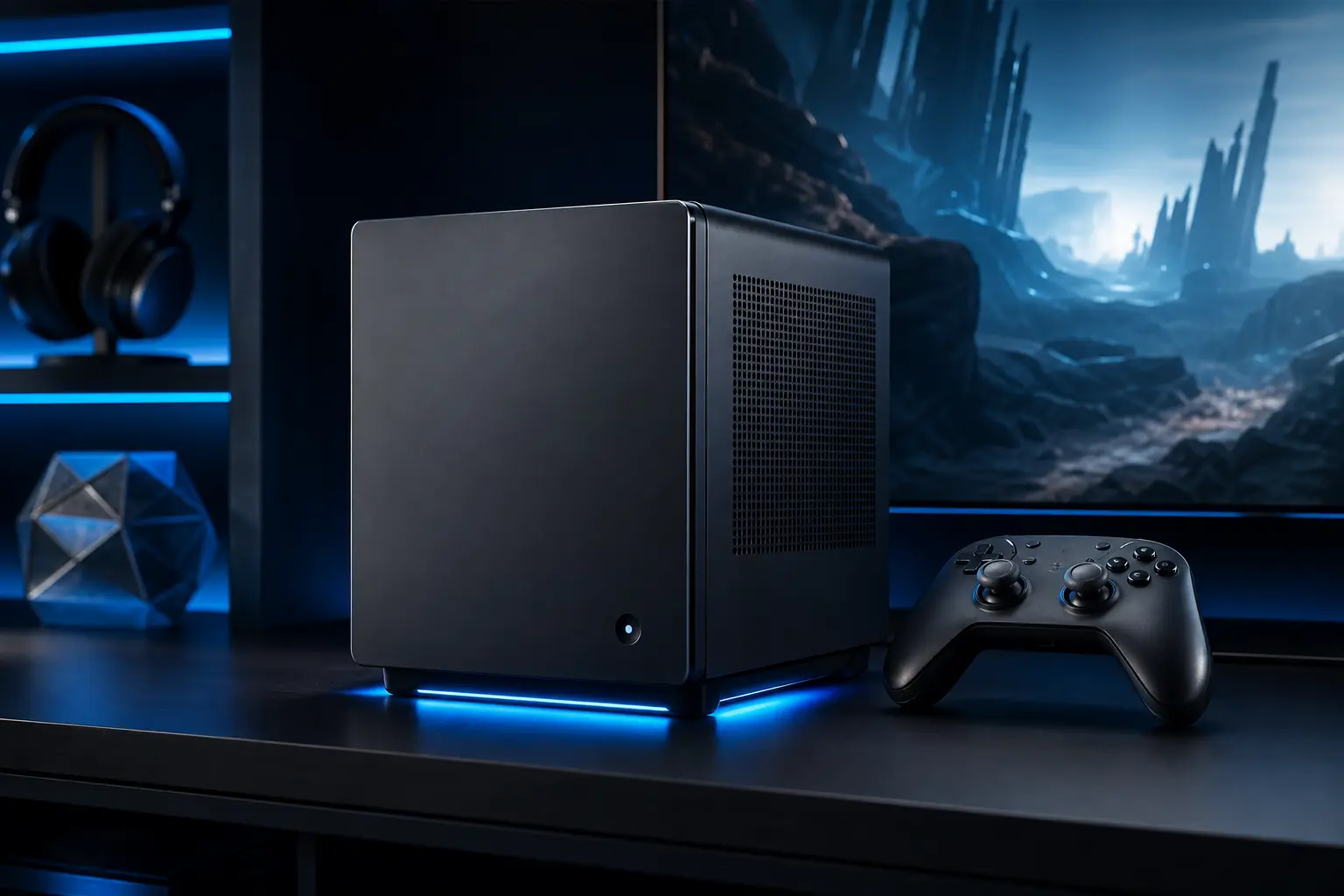
Valve is back in the hardware game in a big way. After years of focusing on the Steam Deck handheld, the company is expanding its hardware lineup in 2026 with three new products: the Valve Steam Machine, the Steam Frame, and a new Steam Controller. For PC gamers, this is the most significant Valve hardware announcement in years — and it raises important questions about what it means for the gaming PC ecosystem.
This guide covers everything you need to know about the Valve Steam Machine 2026: what it is, what specs we know, how it compares to building your own gaming PC, and whether it is worth your money.
What Is the Valve Steam Machine 2026?
The Valve Steam Machine is a living-room gaming PC designed to run SteamOS — Valve’s Linux-based operating system — out of the box. It connects to your TV, accepts a controller, and brings the full Steam library to a console-like form factor without the walled garden of PlayStation or Xbox.
This is not Valve’s first attempt at Steam Machines. The original Steam Machine initiative in 2015 was widely considered a failure, hampered by fragmentation, Linux gaming immaturity, and poor market timing. The 2026 revival is a fundamentally different proposition: SteamOS has matured dramatically with Proton compatibility, the Steam Deck proved there is genuine demand for Linux gaming, and Valve has deep hardware experience it lacked a decade ago.
Valve Steam Machine 2026: What We Know About Specs
Valve has confirmed the Steam Machine lineup is launching in 2026. While full specifications have not been completely disclosed ahead of launch, here is what industry reporting and Valve disclosures indicate:
- Operating System: SteamOS 3 (Linux-based), with the full Steam library via Proton compatibility layer
- Form factor: Compact living-room PC designed for TV connectivity, with passive or near-passive cooling in base configuration
- Controllers: Compatible with the new Steam Controller as primary input, plus full support for all existing Steam Input-compatible controllers
- GPU: Expected to use AMD RDNA 3 or RDNA 4 integrated or discrete graphics depending on tier
- Storage: NVMe SSD with expandable storage via USB and potentially a slot expansion
- Connectivity: HDMI 2.1, USB-A/C, Wi-Fi 6E, Bluetooth 5.3
The Steam Frame: Valve’s Modular Hardware Play
Alongside the Steam Machine, Valve is introducing the Steam Frame — a modular hardware chassis that allows enthusiast upgraders to swap out compute modules as GPU and CPU technology improves. This is a significant design decision that addresses one of the core criticisms of console-like gaming PCs: they go out of date and cannot be upgraded.
The Steam Frame concept allows buyers to invest in the chassis and cooling infrastructure once, then upgrade the compute module (essentially a blade containing CPU, GPU, and memory) as new generations arrive. Think of it as Valve’s answer to the upgrade question that has always distinguished PC gaming from console gaming.
The New Steam Controller
Valve’s 2026 Steam Controller is a significant redesign of its original 2015 effort. The new controller addresses the primary criticism of the original — the awkward dual trackpad layout that most players found inferior to traditional thumbsticks — while preserving the programmability and precision that made Valve’s controller approach distinctive.
The 2026 Steam Controller features traditional thumbsticks alongside high-resolution trackpads, a gyroscope for motion aiming, and haptic feedback. It connects via USB-C and Bluetooth, and integrates natively with SteamOS for per-game configuration profiles that sync across Steam Deck and Steam Machine.
SteamOS 3 in 2026: Why It Matters This Time
The original Steam Machine initiative failed largely because Linux gaming was immature in 2015. Steam games were predominantly Windows executables, and native Linux titles were a fraction of the library. Casual players and even enthusiasts found too many gaps.
The situation in 2026 is categorically different. Valve’s Proton compatibility layer — which translates Windows game calls to Linux — now covers over 80% of the most-played Steam games with full compatibility. Thousands of additional titles work with minor issues. The Steam Deck’s success has given Valve years of real-world data to refine Proton, and game developers increasingly target SteamOS compatibility as a first-class release requirement.
Additionally, SteamOS 3 in 2026 ships with DLSS-equivalent upscaling support via AMD FSR 4, shader pre-compilation to reduce stutter, and a significantly improved Big Picture UI that is genuinely competitive with Xbox and PlayStation dashboards as a living-room experience.
Steam Machine vs. Building Your Own Gaming PC: Key Differences
| Factor | Steam Machine 2026 | Custom-Built Gaming PC |
|---|---|---|
| Setup complexity | Plug-and-play, console-simple | Requires assembly and OS setup |
| Game compatibility | 80%+ Steam library via Proton | Full Windows game library |
| Upgradeability | Limited (Steam Frame changes this) | Fully modular |
| Living-room fit | Designed for TV/couch use | Requires setup work |
| Price | Set by Valve (competitive tiers expected) | Highly variable; can optimize for value |
| Software freedom | SteamOS + Linux apps only | Full Windows ecosystem |
| Noise | Near-silent (optimized cooling) | Variable; depends on build |
Who Should Consider the Steam Machine 2026?
The Living-Room Gamer
If your primary gaming setup is your TV and you want the best possible PC gaming experience without the complexity of a full desktop PC setup, the Steam Machine is built exactly for you. It delivers gaming performance at a price point that competes with gaming consoles while offering access to a library that is orders of magnitude larger.
The Steam Deck Owner Who Wants a Home Base
For Steam Deck users, the Steam Machine is a natural companion. Your library, save states, and controller profiles sync seamlessly between the two devices. The Steam Machine essentially becomes your docked powerhouse when you want the big-screen experience your handheld cannot provide.
Linux Gaming Enthusiasts
For users already comfortable with Linux or interested in moving away from Windows, the Steam Machine is the most polished, well-supported Linux gaming platform available. Valve’s ongoing Proton investment means compatibility continues to improve with every update.
Who Should Stick With a Traditional Gaming PC?
The Steam Machine is not for everyone. If you play games outside Steam — particularly titles from Epic Games Store, Ubisoft Connect, or Activision Blizzard that use anti-cheat systems incompatible with Proton — game compatibility remains a genuine limitation. Competitive multiplayer gamers whose titles of choice use kernel-level anti-cheat (Valorant, some Riot Games titles) will find those games unavailable on SteamOS.
Power users who want maximum flexibility, Windows-exclusive software, or the ability to use their machine for work and gaming with full Windows compatibility are better served by a traditional gaming PC build.
Expected Pricing and Launch Tiers
Valve has historically been aggressive on hardware pricing (see: Steam Deck’s launch price versus competing handhelds). For the Steam Machine 2026, industry analysts expect a tiered lineup:
- Entry tier: ~$399–$499 (targeting 1080p/60fps performance)
- Mid tier: ~$599–$699 (targeting 1080p/120fps or 1440p/60fps)
- Performance tier: ~$799–$999 (targeting 4K/60fps or 1440p/high refresh)
These price points, if accurate, would make the Steam Machine highly competitive with PlayStation 5 Pro and Xbox Series X while offering a significantly larger game library.
Frequently Asked Questions: Valve Steam Machine 2026
What is the Valve Steam Machine 2026?
The Valve Steam Machine 2026 is a living-room gaming PC running SteamOS 3, Valve’s Linux-based operating system. It brings the Steam library to a TV-connected, console-style form factor with the performance and flexibility of a PC, using Proton compatibility to run the vast majority of Steam’s game catalog.
Does the Steam Machine 2026 run all PC games?
The Steam Machine runs over 80% of the most-played Steam games via Proton compatibility. Most single-player and cooperative games work fully. Some titles using kernel-level anti-cheat — particularly certain competitive multiplayer games — are not compatible with SteamOS and cannot be played on the Steam Machine.
What is the Steam Frame?
The Steam Frame is a modular gaming PC chassis from Valve that allows users to upgrade compute modules (containing CPU, GPU, and memory) as hardware generations evolve, without replacing the entire machine. It addresses the traditional weakness of gaming PCs in a set-top form factor: the inability to upgrade.
Is the Steam Machine better than building a gaming PC?
For living-room gaming with a focus on the Steam library, the Steam Machine offers a better experience in terms of simplicity, quiet operation, and couch-friendly usability. For maximum game compatibility, Windows-exclusive software, and flexibility, a custom gaming PC remains the superior choice. The right answer depends on your gaming habits and technical preferences.
When does the Valve Steam Machine 2026 launch?
Valve has confirmed a 2026 launch for the Steam Machine, Steam Frame, and new Steam Controller. Specific launch dates and final pricing are expected to be announced ahead of the product going on sale. Follow Valve’s official Steam store and announcements for the most current release information.
 rabie tahir